


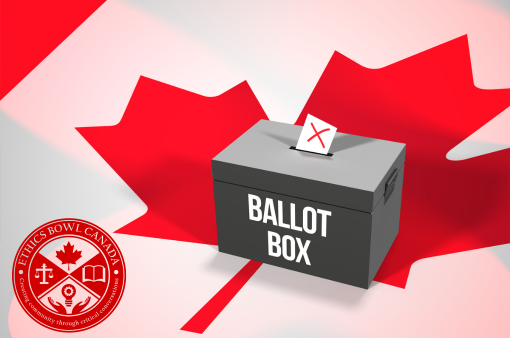
Case Study: Should Canada lower its voting age?
Related Lesson
Lesson C: Constructive Discussion
Downloads
Full Case Study: PDF, Google Doc,
Background: PDF, Google Doc,
Yes: PDF, Google Doc,
No: PDF, Google Doc,
Presented in collaboration with Ethics Bowl Canada. For more information and to access other Ethics Bowl cases, visit https://www.ethicsbowl.ca/

Discussion Prompt
Canada should lower its voting age to 16.
General Background
In 2015, Japan lowered its voting age from 20 to 18 and in 2007, Austria lowered its voting age from 18 to 16. Both nations have experienced high rates of youth voting participation. In July 2025, the UK announced its plans to lower the voting age from 18 to 16 as well. Some Métis nations in Canada already have the minimum voting age set to 16. Should the rest of Canada follow suit?
At Canada’s confederation in 1867, the voting age was 21, which was also the standard voting age for most democracies at that time. Canada experimented with lowered age limits under influential pressure from young people engaged in military service and political life. The voting age was ultimately lowered to include everyone over 18 in 1970, as part of a global movement.
A new demand to lower the age for voting is currently underway.
Questions to consider:
- What kind of credentials do you think should be required of voters?
- Could a system that privileges votes from those with knowledge and expertise, called an epistocracy, lead to a more effective democratic system?
- Would letting 16- and 17-year-olds vote make any significant difference to Canadian politics, or to young people?
For More Information:
Yes
Here are some reasons why someone might argue that Canada should lower the voting age to 16.
Increasing Democratic Representation
Youth are impacted by many of the decisions our government makes. Lowering the vote could further the historical march for democratic representation. A significant youth vote could force politicians to address the specific concerns that younger citizens of Canada have.
16 and 17-year -olds Already have Similar Rights, Responsibilities, and Requisite Knowledge
16- and 17-year-olds already have all or most of the necessary civic knowledge, skills, and cognitive ability to vote responsibly. After all, many drive, work, and pay taxes already. Teens are often already interested in politics, and they have high stakes interests in emergent issues, social opportunities, and economic development.
Increasing Democratic Participation
Lowering the voting age has the potential to increase long-term voter turnout by establishing voting habits early. Moreover, perhaps younger voters can reverse declining democratic participation. Lowering the age of voters might result in a “trickle up” effect, with younger people energizing their families and communities to become more civically engaged alongside them.
No
Here are some reasons why someone might argue that Canada should not lower the voting age to 16.
16- and 17-year-olds lack requisite maturity
16- and 17-year-olds are not ready, knowledgeable, responsible, or mature enough to be given the vote. Many are still developing cognitive and emotional skills that are relevant to political analysis and decision-making. It is for this reason that we do not allow youth to make other big decisions until they reach 18, such as purchasing alcohol or getting married without parental consent.
16- and 17-year-olds lack real world experience
Experience living in the world, and in our particular political system is necessary for making an informed decision when voting. Experience comes with age. 16- and 17-year-olds lack sufficient real-world experience.
There are other forms of political participation more suitable for youth
Voting is only one form of political participation and power. There are other forms of expression and influence that should be considered for youth empowerment first, such as canvassing for political candidates, attending protests, using your platform to raise awareness, writing to your representatives, or attending a Town Hall meeting.
Thank you to Ethics Bowl Canada for allowing the use, adapting, and updating of this case for PoliTalks.